 English
 Deutsch
 Français
 Nederlands
 Español
SHOP AYAHUASCA RETREATS BLOG
Santa, Shamans, and Fly Agaric: The Psychedelic Roots of Christmas

Finn Ashton
June 5, 2026
Your ultimate guide to discover transforming ayahuasca and psychedelic experiences. Dive into serene destinations and elevate your consciousness to unparalled heights.
Discover Ayahuasca & Psychedelic Retreats NowSearch for ayahuasca & psychedelic retreats
Discover retreats, trainings, and holidays from all over the world
Picture a man in red and white robes, sliding down through a hole in the roof in the dead of winter, leaving gifts beneath an evergreen tree. Sounds like Santa. It also sounds suspiciously like a Siberian shaman on a heavy dose of Amanita muscaria — the fly agaric mushroom that grows at the base of pines and birches across the northern hemisphere. The overlap between this peculiar fungus and our modern Christmas iconography is one of the stranger threads in the broader story of psychedelics and human culture, and once you start pulling on it, the whole sweater of holiday tradition begins to unravel in interesting ways.
This isn't fringe internet conspiracy — at least not entirely. Ethnobotanists have been writing about the connection for decades, and while no one can prove a direct line from a Koryak shaman in the 1600s to the Coca-Cola Santa of the 1930s, the parallels are hard to wave away as coincidence. So pour yourself something warm and let's wander through the evidence.
What Does a Mushroom Have to Do With Santa Claus?
The short version: among the Koryak, Kamchadal, Evenki, and other Indigenous peoples of the Russian Far East and Siberia, the fly agaric was — and in some communities still is — a sacred psychoactive. Shamans used it as a tool for divination, especially around the winter solstice, when daylight bottoms out and the new solar year begins to claw its way back. They reportedly dressed in red and white to mirror the mushroom's distinctive cap. They entered yurts (round felt tents) through the smoke hole at the top, because the snow blocked the regular door. They distributed mushrooms as gifts. They spoke of flying through the night sky toward the North Star to gather wisdom for the coming year.
Read that paragraph again and tell me you don't see Santa squinting back at you. The red suit. The chimney entry. The sleigh ride. The annual visit on the longest night. None of this is a smoking gun on its own, but the cumulative weight starts to feel like more than a stretch — especially once you bring the reindeer in.
The Fly Agaric Itself: A Brief and Honest Primer
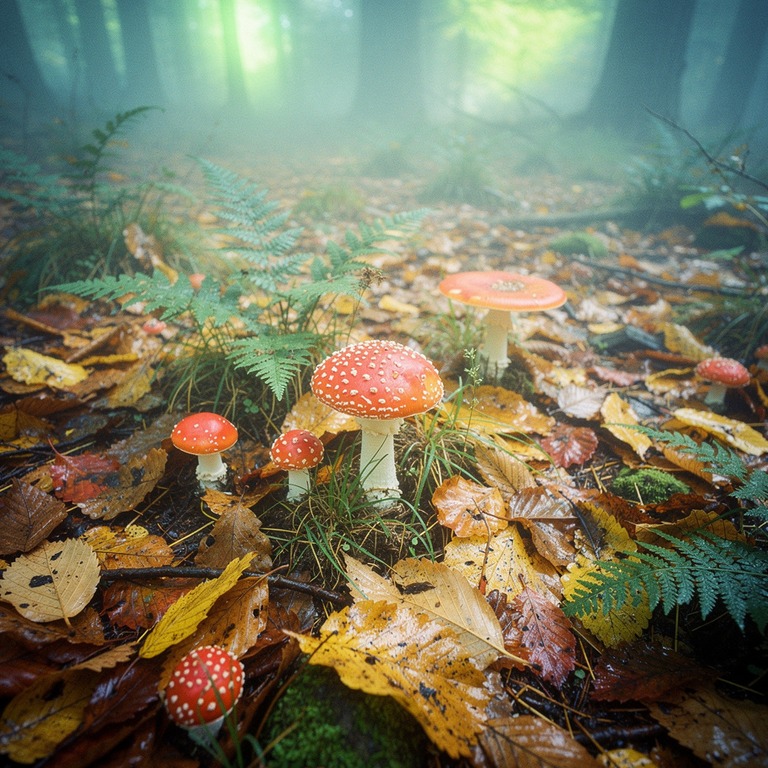
Before going further, it's worth being clear-eyed about what Amanita muscaria actually is. It's a mycorrhizal fungus that grows in symbiosis with the roots of certain trees — birch, pine, spruce — which is why it can't be cultivated commercially and has to be foraged. It contains two main active compounds: ibotenic acid and muscimol. Ibotenic acid is essentially the prodrug; the body slowly converts it into muscimol, which is the compound responsible for the bulk of the experience.
Importantly, fly agaric is not a classic psychedelic in the way psilocybin mushrooms or ayahuasca are. It doesn't act on serotonin 5-HT2A receptors. Instead, muscimol is a GABA-A agonist — it works on the same receptor system as alcohol and benzodiazepines, just from a very different angle. The result is something more dreamlike, dissociative, and unpredictable than a typical psilocybin journey.
Reported effects include:
- Vivid, often lucid-feeling dreams or waking visions
- Synaesthesia (sounds with colour, that kind of thing)
- Macropsia and micropsia (things appearing huge or tiny — yes, Alice in Wonderland)
- A peculiar mix of sedation and stimulation, sometimes at the same time
- Out-of-body sensations and a feeling of flight
- Muscle twitches, sweating, and nausea
- Delirium and confusion at higher doses
Effects typically peak around three hours in and can last anywhere from ten to twenty-four hours. The raw mushroom is genuinely toxic and people do get seriously sick from eating it improperly. Traditional preparation — drying, repeated boiling, or the rather notorious reindeer-urine method — converts most of the ibotenic acid to muscimol and reduces the worst side effects. This is not a casual snack.
Flying Reindeer, Red Noses, and a Slightly Disgusting Workaround
The reindeer connection is where the story gets gleefully strange. Reindeer in Siberia love fly agaric. They seek it out, dig it from beneath the snow, and eat it apparently for its psychoactive effect. They tolerate the toxins in ways humans don't. The herders noticed this. They also noticed something else: the muscimol passes through the reindeer's body largely intact and ends up in the urine.
So — and there's no polite way to say this — people drank the urine. Either straight from the snow or collected from the animal directly. It was a brilliant pharmacological hack: the reindeer's metabolism filtered out most of the nasty stuff, leaving a relatively cleaner psychoactive product. Some accounts even describe the urine being passed from person to person, with muscimol staying potent through several recyclings.
Once you know this, the image of reindeer prancing through the sky with a slightly delirious-looking man in red takes on a whole new dimension. And Rudolph's glowing red nose? Probably a stretch — but the most famous red thing in the snowy north, the thing that made reindeer matter to these cultures in the first place, was a mushroom with a bright red cap. Make of that what you will.
Why the Tree, the Stockings, and the Solstice?
The Christmas tree is one of the most curious customs in the Western calendar. Why drag an evergreen indoors in December? Pre-Christian solstice traditions across northern Europe revered evergreens as symbols of life persisting through winter death, and that's the standard explanation. But there's a more specific reading too.
Fly agaric only grows beneath certain trees — pines, birches, spruces — because it needs their roots to survive. In Siberian cosmology, these trees were sometimes seen as cosmic axes connecting earth to sky, and the mushrooms that appeared beneath them were considered gifts from the tree itself. Foragers would gather them from under the branches, much the way children today gather presents from under a decorated fir.
The drying process adds another layer. To reduce toxicity, the mushrooms were often hung from tree branches to dry in the cold winter air. Bright red caps dangling from evergreen boughs. Sound like ornaments yet? Other accounts mention drying them in stockings hung above the fireplace, the heat slowly removing moisture without cooking off the active compounds. Stockings by the fire. On the longest night of the year. Waiting for something.
Odin, Sleighs, and the Migration of a Story
As these traditions drifted west and tangled with Norse and Sami practice, new versions emerged. There's a thread in Nordic folklore involving Odin riding the night sky on his eight-legged horse Sleipnir during the midwinter Wild Hunt. In some tellings, blood or saliva dripped from the horse's mouth as it galloped, and where those droplets fell, fly agaric mushrooms grew the following season. Eight reindeer. Eight-legged horse. Probably not unrelated.
The Sami of northern Scandinavia, who herd reindeer to this day, had their own shamanic traditions involving fly agaric. Their drums were sometimes painted with the mushroom's image. Their noaidi (shamans) wore red and white. Their cosmology mapped neatly onto solstice timing. As Christianity spread north and absorbed local custom — as it almost always did — these elements didn't disappear; they simply got reassigned.
So Is Any of This Actually True?
Here's where I have to be honest with you. The fly-agaric-equals-Santa theory is popular, it's fun, and parts of it are well-documented. But it's also been disputed by serious scholars. The historian Ronald Hutton, who knows more about British and northern European folk tradition than almost anyone alive, has pushed back on the strongest versions of the claim. He argues that fly agaric use was less widespread than the popular story suggests, that Siberian shamans didn't dress in red and white as a uniform, and that the modern Santa is mostly a product of nineteenth-century American writers and illustrators — Clement Clarke Moore, Thomas Nast — drawing on Dutch Sinterklaas traditions.
That's a fair correction. The Coca-Cola red-suit Santa really did come from a 1930s advertising campaign, even if the colour scheme already existed in earlier illustrations. Saint Nicholas of Myra was a real fourth-century bishop with no obvious mushroom connections. And a lot of the more specific claims — about chimneys, about reindeer urine, about gifts under trees — get sharper and more dramatic each time they're retold online.
The reasonable middle ground goes like this: Siberian and northern European peoples did use fly agaric ceremonially. Their solstice practices did involve reindeer, evergreens, red-and-white symbolism, and ecstatic flight. These traditions did drift south and west over centuries, mingling with Christian and folk customs. Whether they directly shaped Santa Claus is unprovable — but to say they had zero influence on the broader symbolic vocabulary of midwinter celebration feels equally unsupportable.
Where Fly Agaric Fits in the Modern Psychedelic Conversation
Fly agaric is having a quiet moment. As psilocybin and ayahuasca have moved into mainstream conversation, Amanita muscaria has crept along behind them, partly because it occupies a strange legal grey zone in many countries — unlike classic psychedelics, it isn't scheduled in most of the US, the UK, or the EU. You can find it sold openly, sometimes in gummies or tinctures, which is not the same as saying it's a good idea to use it casually.
It's a different animal from the serotonergic psychedelics most retreat-seekers are researching. The experience is harder to predict, the dose-response curve is steeper, and the risk of an unpleasant or genuinely toxic episode is real. People who work with it traditionally do so with deep knowledge of preparation methods passed down through generations. Most of us don't have that. If you're curious about plant medicine for healing addiction, depression, or trauma, fly agaric is probably not the first door to open — ayahuasca, psilocybin, and ibogaine all have substantially more clinical research and a much longer track record of facilitated, ceremonial use in modern retreat settings.
Still, the mushroom matters culturally. It's a reminder that the human relationship with master plants and psychoactive fungi is ancient, that it's woven into rituals we still perform without realising what we're doing, and that the line between religion, medicine, and altered states has always been blurrier than tidy modern categories suggest. If your interest in psychedelics is partly a search for older, deeper ways of marking time and meaning, a range of ayahuasca, psilocybin, and other plant-medicine retreats can be browsed on our marketplace here.
One Last Thought Before You Go Decorate the Tree
Whether or not Santa is a Siberian shaman in disguise, there's something worth holding onto in the story. Midwinter is when human beings have always reached for the strange — for ritual, for light in the dark, for some hint that the year is going to turn and the sun will come back. That instinct predates Christianity, predates Coca-Cola, predates the mushroom theory itself. It probably predates language.
So this December, when you string up red and white ornaments and hang stockings by a fire and put presents under an evergreen tree, you might be participating in a tradition far older and weirder than the carols suggest. Worth a quiet nod to the reindeer, at least.

Craving More Stories?
Join our ShopAyahuascaRetreats newsletter for the latest updates on thrilling
destinations and inspirational tales, delivered straight to your inbox!
We value your privacy. Your email address will never be shared or published.