 English
 Deutsch
 Français
 Nederlands
 Español
SHOP AYAHUASCA RETREATS BLOG
Reading Ayahuasca Art: What Vine-Inspired Imagery Actually Reveals
Lila Novak
November 15, 2026
Your ultimate guide to discover transforming ayahuasca and psychedelic experiences. Dive into serene destinations and elevate your consciousness to unparalled heights.
Discover Ayahuasca & Psychedelic Retreats NowSearch for ayahuasca & psychedelic retreats
Discover retreats, trainings, and holidays from all over the world
Scroll through any ayahuasca forum long enough and you'll run into the art. Snakes coiled around tree trunks. Geometric latticework pulsing in impossible colors. A woman with a jaguar's face, or a jaguar with a woman's eyes. Some of it is clumsy. Some of it is extraordinary. Almost all of it is trying to say the same thing: this is what I saw, and I don't have the words.
If you're researching an ayahuasca retreat and you've been quietly studying this imagery — trying to figure out what any of it means, whether it's romanticized, whether people actually see this stuff — you're asking a smarter question than you realize. Plant medicine art is one of the few honest records we have of what the ceremony does to the mind. It's not marketing. It's reporting.
Why Ayahuasca Shows Up as Art in the First Place
The visual intensity of an ayahuasca ceremony is not a side effect. For many people it's the main event. DMT, the primary psychoactive in the brew, produces visions of a particular character: geometric, biological, often serpentine, sometimes narrative. The vine (Banisteriopsis caapi) and the DMT-containing leaf (usually chacruna) combine to create an experience that can last four to six hours — long enough to see a lot, and remember most of it.
The problem is language. English wasn't built for this. Neither was Spanish or Portuguese or Quechua, really, though the Indigenous traditions have had thousands of years to develop vocabulary that at least gestures at the territory. So people draw. They paint. They sew the visions into textiles. The Shipibo of the Peruvian Amazon are the most famous example — their intricate kene patterns are said to be direct transcriptions of ayahuasca visions and the icaros (healing songs) sung in ceremony.
Walk into a Shipibo-run maloca and you'll see those patterns on the walls, on tapestries, sometimes painted on the ceremony cups themselves. They're not decoration. They're a map.
The Recurring Motifs — and What People Actually Report Seeing
If you spend time with ayahuasca-inspired work, certain images keep returning. Not because artists copy each other (though some do), but because the experiences themselves cluster around recognizable forms.
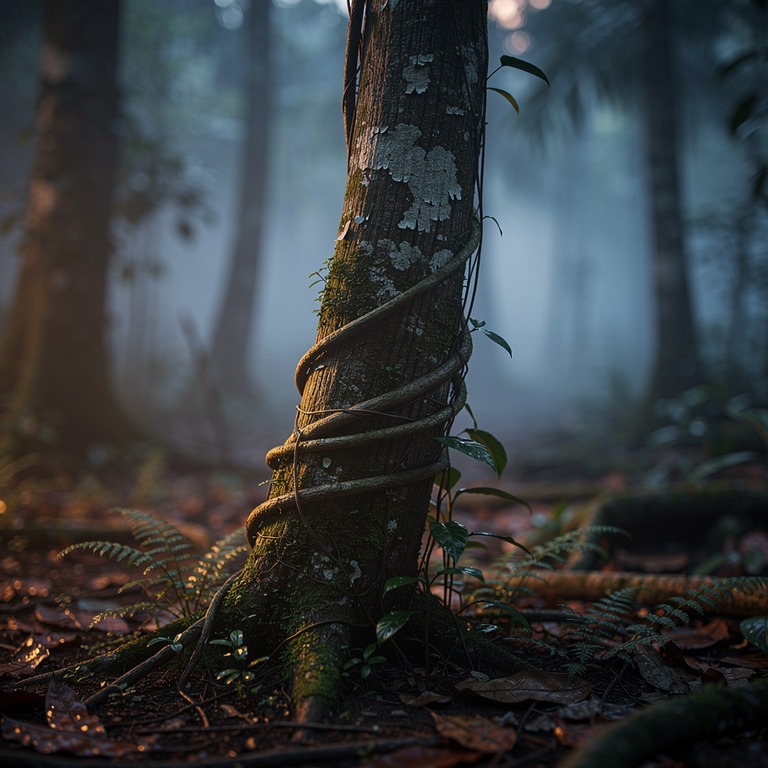
- Serpents. Overwhelmingly common. Often huge, often colored in impossible iridescence, often moving through or around the person. In many Amazonian traditions, the anaconda is considered a direct manifestation of the ayahuasca spirit — Madre Ayahuasca herself.
- Geometric lattice. Interlocking diamonds, hexagons, grids that pulse and breathe. Some neuroscientists think these reflect the underlying architecture of the visual cortex becoming briefly visible. Others, including most shamans, think that's a boring explanation.
- Jaguars and large cats. Guardians, teachers, sometimes aggressors. The jaguar in Amazonian cosmology is the shaman's twin, the animal that crosses between worlds.
- Luminous plants. Trees and vines depicted as glowing from within, often with faces or eyes. This maps onto the concept of master plants — the idea that certain species are sentient teachers, not just chemistry.
- Cities, temples, beings. Elaborate architecture and entities that feel older than the person seeing them. These are harder to explain away.
None of this means every person who drinks ayahuasca will see snakes and jaguars. Plenty of people have quiet, body-centered experiences with almost no imagery at all. But when visions do come, they tend to come in dialects the art has already documented.
Is This Art Just Decoration, or Does It Actually Teach You Something?
Here's where I think a lot of first-time retreat-goers get the wrong idea. They look at the art online, get excited, and show up expecting a light show. Then the medicine hands them something else entirely — grief, a childhood memory, nausea, the sense that their mother is sitting in the room — and they feel like they got the wrong experience.
You didn't. The visual stuff is one layer. The art captures that layer because it's the one you can actually paint. Harder to render: the feeling of being forgiven. The understanding, for ninety seconds, of why you drink. The specific tone of your father's voice when he said the thing he never apologized for. Ayahuasca art tends to be gorgeous because artists reach for gorgeous when the actual content is unspeakable.
That said — looking at this work before a retreat can be genuinely useful. Not as a preview, but as a kind of permission. It tells your nervous system: other people have gone where you're going, and they came back with something worth making.
The Shipibo Lineage and Why It Matters
If you're choosing an ayahuasca retreat, you'll encounter the word Shipibo constantly. There are good reasons for that and some uncomfortable ones.
The good reasons: the Shipibo-Konibo people of the Ucayali river basin have one of the most sophisticated and continuous ayahuasca traditions on earth. Their healers (onanya) train for decades, sit long dietas with specific master plants, and work through song. The kene patterns you see in their textiles and ceremonial art correspond to the icaros they sing — song and image are two expressions of the same medicine. Sitting in a Shipibo ceremony, when the maestra starts singing, you can sometimes see what she's singing. People have reported this independently for a century. It's weird and it's real.
The uncomfortable reasons: Shipibo iconography has been pulled into global ayahuasca tourism in ways that don't always benefit the communities that created it. If a retreat is selling you Shipibo-style everything, ask who's actually running the ceremonies, where they trained, and how the community is compensated. A thoughtful operator will answer clearly. A shady one will get vague.
How to Look at Ayahuasca Art Without Romanticizing the Medicine
A few honest notes for anyone using this imagery as part of their research:
- Beautiful art doesn't mean beautiful ceremony. Some of the most striking ayahuasca paintings came out of experiences the artist describes as brutal. The vine has a reputation for being gentle. It is not always gentle.
- Be suspicious of retreats that lean entirely on aesthetics. Glossy Instagram feeds, perfect lighting, uniformed facilitators — these are marketing. The actual work happens in dim rooms that smell like mapacho smoke and, occasionally, vomit.
- Western psychedelic art and traditional Amazonian art are not the same thing. Both can be valuable. But a Alex Grey print and a Shipibo tapestry are coming from different cosmologies. Know which one you're looking at.
- The art is a door, not the room. Looking at paintings of ayahuasca visions is roughly as close to drinking ayahuasca as reading a menu is to eating dinner. Useful. Not the thing.
What This Means If You're Weighing a Retreat
Plant medicine art, taken seriously, is one of the most honest introductions you'll get to the territory. It shows you that the ceremony is not a wellness experience, not a vacation, not a brain hack. It's a tradition with its own grammar, its own teachers, and its own long memory. The snakes and the geometries aren't invented by artists — they're reported by them.
If you're considering ayahuasca as part of working through addiction, depression, trauma, or a life that's gotten stuck in a loop, the best advice I can offer is this: look at the art, read the honest accounts, and then look harder at the retreat itself. Who runs it. Where they trained. How they handle integration after you go home, which is where most of the actual healing happens. For readers wanting to go further, a range of vetted ayahuasca retreats can be browsed on our marketplace here.
The paintings will still be waiting when you come back. You might understand them differently.
Craving More Stories?
Get your free guide on how to choose a psychedelic retreat, plus upcoming retreats and new reading every two weeks.
We value your privacy. Your email address will never be shared or published.