 English
 Deutsch
 Français
 Nederlands
 Español
SHOP AYAHUASCA RETREATS BLOG
Psilocybe Azurescens: The Most Potent Magic Mushroom and How It's Grown

Ezra Caldwell
May 18, 2026
Your ultimate guide to discover transforming ayahuasca and psychedelic experiences. Dive into serene destinations and elevate your consciousness to unparalled heights.
Discover Ayahuasca & Psychedelic Retreats NowSearch for ayahuasca & psychedelic retreats
Discover retreats, trainings, and holidays from all over the world
If you've spent any time reading about psychedelic mushrooms, you've probably bumped into the name Psilocybe azurescens — usually wrapped in superlatives. The strongest. The wildest. The one that grows in the dunes. Most of that hype is actually true, which is rare for a corner of the plant-medicine world that loves a tall tale. Azurescens is a genuinely remarkable little mushroom with a short, strange history and a personality of its own.
This is a closer look at where it came from, why it punches so hard, and what's involved if you ever wanted to grow it — written for the curious reader, not the commercial cultivator. Whether you're researching psilocybin out of personal interest or weighing it as part of a broader interest in psychedelics and master plants, knowing the basics about this species is worth your time.
What Exactly Is Psilocybe Azurescens?
Azurescens is a wood-loving species native to a slim stretch of the Pacific Northwest coast in the United States — think the Oregon and Washington shoreline, where conifer debris, dune grass, and damp salt air meet. It's a relative newcomer to mycology. The species was formally described in 1996 by Paul Stamets and Jochen Gartz, after being noticed years earlier by a group of Boy Scouts camping near the mouth of the Columbia River. The story goes that one of them was Stamets' son. Whether that origin tale is fully accurate or partly folklore, the mushroom got its scientific name and its nickname — “Flying Saucer Mushroom,” for the wavy, UFO-shaped caps it produces in cool weather.
What sets azurescens apart isn't its looks, though. It's the chemistry. By dry weight, this species contains some of the highest concentrations of psilocybin, psilocin, and baeocystin ever measured in a wild mushroom. Roughly speaking, it tests at around three times the potency of the more familiar Psilocybe cubensis — the species behind nearly every store-bought grow kit and most underground supply. That fact alone is responsible for a lot of azurescens' reputation, and a lot of trouble for the unprepared.
How It Looks in the Wild
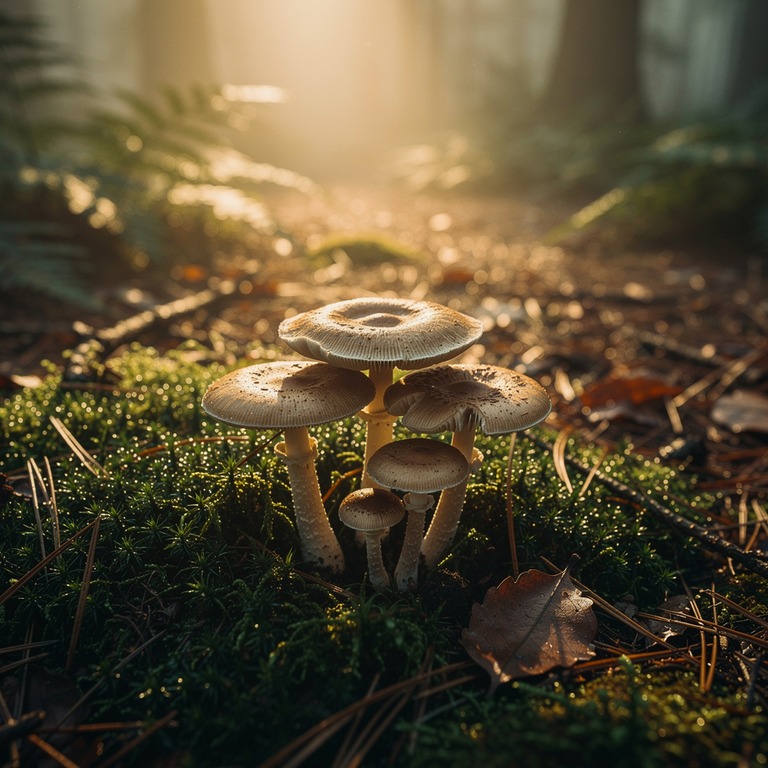
Caramel-brown caps that flatten out and develop a slight nipple in the centre. A whitish stem that bruises a vivid blue-green when handled — the classic signature of psilocybin-bearing species. Dark purple-brown spores. It tends to fruit in clusters on woody debris, often hidden under dune grass, between September and January when temperatures drop into single digits Celsius. Cold is part of its lifestyle, not an obstacle to it.
Why the Potency Matters More Than You Think
Three times the strength of cubensis is not a marketing line — it's a practical warning. A dose of dried azurescens that would fit on a teaspoon can produce an experience that, with cubensis, would require a small handful. People accustomed to gauging mushroom doses by volume rather than weight have learned this the hard way. Reports of temporary paralysis at higher doses of azurescens circulate widely in mycology forums, and while the phenomenon isn't fully understood, it appears often enough that it deserves to be taken seriously.
Beyond raw intensity, the experience is frequently described as more visual, more “alien,” and harder to steer than a comparable journey on cubensis. Whether that's pharmacology or expectation effect is up for debate. What isn't debatable is that this is not a beginner mushroom, and nobody should be approaching it as a casual weekend experiment. If you're newer to psilocybin and curious about the deeper end of the experience, a properly guided ceremony in a country where it's legal — Netherlands, Jamaica, certain parts of the U.S. — is a far safer doorway than a dune walk on the Oregon coast.
Growing Azurescens: Realistic Expectations
People hear “most potent mushroom in the world” and immediately want to grow it. Understandable. The reality is that azurescens is one of the more demanding species in the genus to cultivate, and it doesn't reward shortcuts. Unlike cubensis, which colonises grain and fruits indoors on a rye-cake at room temperature in a few weeks, azurescens wants what it has in the wild: wood, cold, and patience.
Here's the short version of how outdoor cultivation typically works:
- Substrate. Hardwood chips — alder is the traditional favourite — mixed with a smaller portion of straw. The mushroom is a wood-decomposer, not a dung-lover.
- Bed location. A shaded outdoor patch, ideally with morning sun and afternoon shade. Many growers use a wooden frame sunk a few inches into the ground.
- Inoculation. Grain spawn is mixed into the wood-chip bed and then covered and watered. Sterile technique matters here — contamination is the most common reason beds fail.
- Waiting. Colonisation takes months, not weeks. Many growers wait a full year before seeing any fruits, and a bed that produces nothing the first autumn often comes alive the second.
- Fruiting trigger. Drops in nighttime temperature, usually below 16°C, signal the mycelium to fruit. Indoor cultivation is technically possible but rarely produces the same yields.
Indoor attempts using terrariums and refrigerated fruiting chambers exist, but the consensus among experienced cultivators is that azurescens is fundamentally an outdoor species. Trying to force it indoors usually means a long wait followed by disappointment.
The Legal Reality
This is the part nobody likes. Psilocybin remains a controlled substance in most of the world, including the United States — yes, even though azurescens grows wild there. Cultivation, possession, and distribution carry real legal consequences in most jurisdictions. A small number of places have decriminalised personal use (Oregon, parts of Colorado, the Netherlands' truffle loophole), but “decriminalised” and “legal” are not the same thing, and the picture changes constantly. Before doing anything, check the law in your actual location, not the one you wish you lived in.
Where Azurescens Fits in the Bigger Psychedelic Picture
There's a tendency in psychedelic circles to chase potency — to assume that stronger means better, deeper, more transformative. It doesn't. Some of the most useful psilocybin experiences happen at moderate doses with capable guides, in settings designed for integration. The reason a species like azurescens fascinates so many people isn't really about the milligram count. It's the romance of the wild — a powerful master plant fruiting on a windy beach in the rain, indifferent to anyone's intentions for it.
If that romance is what's drawing you, it's worth asking what you actually want. Self-knowledge? Help with a stuck depression or an addiction pattern? Curiosity about consciousness? Each of those goals points toward different settings and different medicines. Ayahuasca ceremonies in the Peruvian Amazon, ibogaine programmes for opioid dependency, psilocybin retreats in Jamaica or the Netherlands — these are structured environments with people whose job is to keep you safe and help you make sense of what comes up. A wild-foraged batch of the world's strongest mushroom is the opposite of that.
Plant medicines work best when you bring them context. Set, setting, and integration aren't buzzwords; they're the difference between an experience that reshapes your year and one that just shakes you. For readers who want to take this curiosity further in a held container rather than a solo experiment, a range of curated psilocybin and plant-medicine retreats can be browsed on our marketplace here. Whatever path you choose, choose it with both eyes open — these mushrooms have been doing this far longer than we have, and they deserve some respect.

Craving More Stories?
Join our ShopAyahuascaRetreats newsletter for the latest updates on thrilling
destinations and inspirational tales, delivered straight to your inbox!
We value your privacy. Your email address will never be shared or published.