 English
 Deutsch
 Français
 Nederlands
 Español
SHOP AYAHUASCA RETREATS BLOG
Datura: Why This Plant Isn't the Psychedelic You Think It Is

Ivy Chan
September 21, 2026
Your ultimate guide to discover transforming ayahuasca and psychedelic experiences. Dive into serene destinations and elevate your consciousness to unparalled heights.
Discover Ayahuasca & Psychedelic Retreats NowSearch for ayahuasca & psychedelic retreats
Discover retreats, trainings, and holidays from all over the world
Every few months, someone shows up in a psychedelic forum asking a version of the same question: I have access to a lot of datura growing wild near my house. Should I try it? The answers, from anyone who actually knows the plant, tend to arrive fast and unanimous. Don't. And if you're still curious after reading this, probably still don't.
Datura sits in a strange corner of the plant medicine world. It's technically a psychoactive plant with a long history of shamanic use, which makes people file it mentally next to ayahuasca or San Pedro. That's a mistake. Datura is not really a psychedelic in the way most seekers use the word. It's a deliriant, and the difference matters more than almost anything else you'll read about it.
What Datura Actually Is
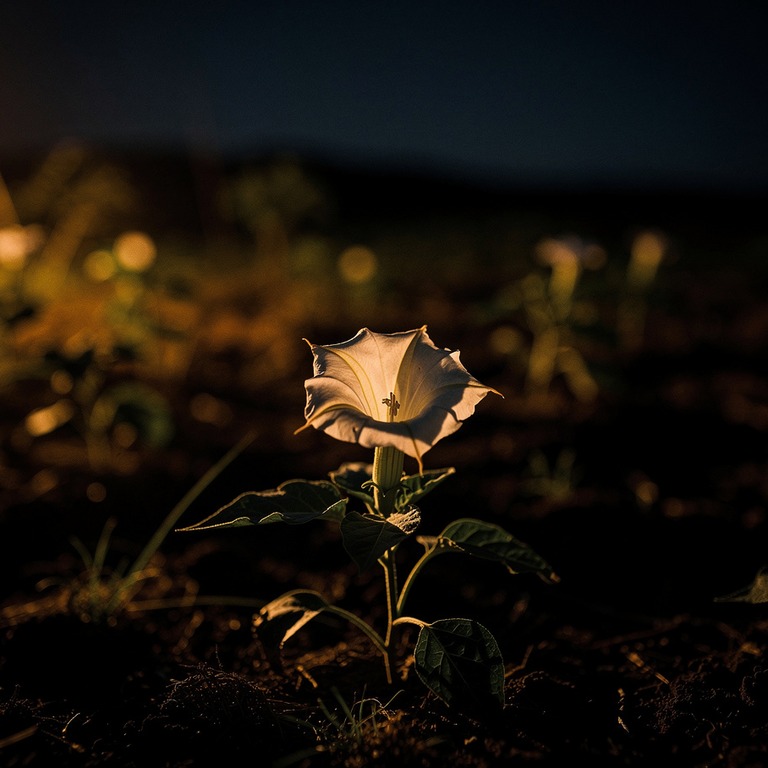
Datura is a genus of flowering plants in the nightshade family — cousins to belladonna, mandrake, and henbane. The trumpet-shaped flowers are genuinely beautiful, which is part of the problem. They look inviting. They grow in ditches, backyards, and vacant lots across most of the world. In some regions the plant is so common that people treat it as a weed.
The active compounds are tropane alkaloids — mainly scopolamine, atropine, and hyoscyamine. These are the same chemicals that, in tiny medical doses, are used for motion sickness patches and pre-surgical dry-mouth medications. In the doses required to produce a visionary experience, they cross into a completely different territory. This isn't serotonergic psychedelia like psilocybin or DMT. It's anticholinergic delirium, and the phenomenology is closer to a high fever with hallucinations than to a mushroom trip.
People who've taken datura and lived to describe it coherently — which, notably, is not everyone who tries it — rarely describe insight or beauty. They describe convincingly real hallucinations of people who aren't there, entire conversations with phantoms, complete loss of the ability to distinguish thought from reality, and days of physical wreckage afterward.
Why Experienced Facilitators Steer Clear
Talk to almost any curandero, ayahuascero, or seasoned Western facilitator about datura and you'll get some version of a wince. In parts of the Amazon and the American Southwest, datura and its relatives (toé, brugmansia, jimsonweed) are known and occasionally used — but almost always in tiny, calibrated doses, often blended into other preparations by people with decades of training. It's treated as one of the most dangerous plant teachers in the pharmacopoeia. Not the deepest. Not the wisest. The most dangerous.
The reasons are practical and specific:
- The therapeutic window is razor-thin. The dose that produces visions and the dose that stops your heart or triggers a multi-day psychotic break can be almost the same. Alkaloid concentrations vary wildly between plants, between parts of the same plant, and between seasons. There's no reliable way to dose a wild specimen without a lab.
- The experience is not insight-oriented. Deliriants don't tend to produce the reflective, meaning-rich states people seek from ayahuasca or psilocybin. Users often can't remember what happened, or remember events that never occurred.
- Physical toxicity is real. Racing heart, dangerously high body temperature, urinary retention, seizures. Emergency rooms see datura cases every summer, and some of them don't leave.
- The comedown is brutal. Blurred vision, cognitive fog, and lingering hallucinations can last days. Some people report cognitive effects for weeks.
The Difference Between a Psychedelic and a Deliriant
This distinction gets lost constantly, so it's worth spelling out. Classical psychedelics — psilocybin, LSD, DMT, mescaline — work primarily on serotonin receptors. You know you've taken something. You can usually navigate. The visions feel meaningful, sometimes overwhelming, but there's a persistent thread of self that observes.
Deliriants work by blocking acetylcholine, a neurotransmitter involved in memory, attention, and the basic distinction between what's happening in the room and what's happening in your head. Under a deliriant, that distinction dissolves. You don't hallucinate a shimmering pattern on the wall. You hallucinate your dead grandmother sitting on the couch, and she's completely real, and you have a full conversation with her, and later you'll insist it happened. That's a categorically different kind of experience — and it's why people who work with plant medicines for healing don't reach for datura.
The plant does have a place in traditional practice, but usually as a plant to be studied, respected, and largely avoided rather than ingested. Some Indigenous teachers describe it as a jealous or trickster spirit — a plant that can teach, but which extracts a heavy price and doesn't much care about the wellbeing of the person who approaches it carelessly.
What About Access? The Trap of Availability
Here's the specific pattern that shows up in those online questions. Someone finds datura growing near their house. It's free. It's legal in most places (because nobody wants to eat it). They've read that it's psychoactive. They start thinking, why not?
Availability isn't a signal. Poison hemlock is also free and grows wild. The fact that a plant is easy to obtain tells you nothing about whether it belongs in your body. The plants that humans have gathered around ceremonially — the ones with real healing potential — are usually the ones with a long apprenticeship attached. You don't work with ayahuasca alone in your kitchen because you found some vine. You don't work with iboga because you ordered root bark online. The same principle applies here, with more urgency, because datura will hurt you faster and less predictably than either.
If you're drawn to plant medicine because you're stuck — depressed, addicted, traumatized, feeling like your life has flattened out — datura is the wrong door. It won't give you what you're looking for, and there's a real chance it takes something from you instead. The impulse behind the search is legitimate. The plant isn't the answer.
Where to Actually Look Instead
If you've been reading about plant medicine and something in you keeps returning to the idea that a psychedelic experience might help, there are more established paths worth researching first. Ayahuasca ceremonies in Peru, Costa Rica, or increasingly Europe. Psilocybin retreats in Jamaica, the Netherlands, and legal-therapeutic settings in Oregon and Colorado. Ibogaine programs in Mexico for people specifically working on addiction. San Pedro (huachuma) circles in the Andes for something gentler and more heart-centered.
Each of those has real risks and real screening requirements — cardiac issues, medication interactions, mental-health histories all matter. But they're worked with in structured settings by people who've done it thousands of times, who know how to hold a difficult experience, and who don't leave you alone in the middle of the night wondering what's real. That kind of container is the actual medicine, arguably more than the plant itself.
A few practical questions worth asking before you commit to any retreat:
- How long has the facilitator been running ceremonies, and with which tradition?
- What's the medical and psychological screening process?
- What's the ratio of participants to experienced staff?
- How do they handle emergencies — both physical and psychological?
- What integration support exists after you go home?
If any of those questions get vague answers, keep looking. The good operators expect the questions. They're the ones you want.
Datura will still be growing in the ditch when you get back. It'll keep growing there. That's fine. Some plants are worth admiring from a distance, and this is one of them. For those interested in exploring plant medicine through paths with better safety records and genuine therapeutic depth, a curated selection of ayahuasca, psilocybin, and other plant-medicine retreats can be browsed on our marketplace here.

Craving More Stories?
Join our ShopAyahuascaRetreats newsletter for the latest updates on thrilling
destinations and inspirational tales, delivered straight to your inbox!
We value your privacy. Your email address will never be shared or published.