 English
 Deutsch
 Français
 Nederlands
 Español
SHOP AYAHUASCA RETREATS BLOG
Ayahuasca and Nature: What an Amazonian Retreat Actually Does to Your Mind

Finn Ashton
May 19, 2026
Your ultimate guide to discover transforming ayahuasca and psychedelic experiences. Dive into serene destinations and elevate your consciousness to unparalled heights.
Discover Ayahuasca & Psychedelic Retreats NowSearch for ayahuasca & psychedelic retreats
Discover retreats, trainings, and holidays from all over the world
There's a moment, somewhere around the third or fourth ayahuasca ceremony, when people start saying odd things. Not visionary things — those come earlier. I mean the quiet remarks at breakfast about a particular tree, or the way someone keeps drifting back to the same stretch of riverbank between ceremonies. Something has shifted in how they're seeing the place.
For years, this kind of report sat in the anecdotal pile. Trip stories. Integration journals. The sort of thing you hear at a retreat but rarely see written up in a journal with proper statistics attached. That's begun to change. A pilot study published in Drug Science, Policy and Law looked at exactly this question — does sitting with ayahuasca in the Amazon actually change a person's felt connection to nature? — and the answer, with the usual caveats, appears to be yes.
What the Researchers Actually Did
The team followed 43 participants through an Indigenous-led ayahuasca retreat at the Ayahuasca Foundation, a center deep in the Peruvian Amazon. The ceremonies were conducted in an adapted Shipibo format, led by Indigenous shamans, with participants attending anywhere from four to eleven ceremonies over stays that ranged from ten days to a full month. The average person sat in roughly six ceremonies.
Before their first ceremony and the morning after their last, participants filled out a set of standardized inventories. Two measured what psychologists call “nature relatedness” — essentially, how deeply you feel woven into the natural world rather than separate from it. The other measured depression, anxiety, and stress. Nothing exotic about the instruments. These are the same scales used in plenty of mainstream psychology research.
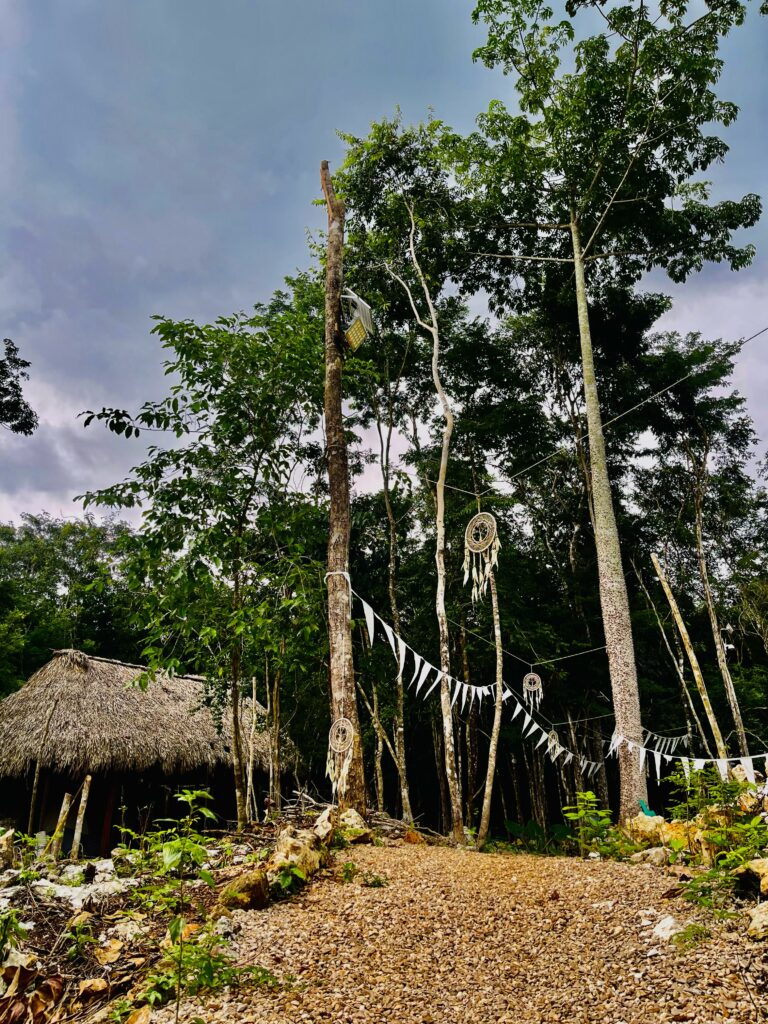
What makes this study slightly unusual isn't the methodology. It's the setting. Most psychedelic research happens under fluorescent lights in clinical rooms. This one happened in a maloca surrounded by jungle, with no cell service, limited electricity, and the constant hum of insects and frogs as the soundtrack to every ceremony.
The Results, in Plain English
Three things moved significantly between pre- and post-retreat measurements:
- Nature relatedness scores rose on both scales used, with medium-to-large effect sizes.
- Depression scores dropped substantially — average scores on the depression subscale roughly halved.
- Stress scores also dropped, by a similar margin.
One thing didn't move: anxiety. Scores on the anxiety subscale were essentially flat. The researchers offer a reasonable explanation — being at a remote jungle retreat, away from everything familiar, drinking a brew that has a reputation for being intense, is itself an anxiety-provoking situation. The questionnaire was asking about the past week, and the past week included some genuinely nerve-rattling experiences. So a null result there isn't really a failure; it's an honest read of the environment.
The more interesting finding is the correlation between the changes. People whose nature relatedness rose the most also tended to be the ones whose stress dropped the most. That link held up statistically. Whatever was shifting in their relationship to the natural world seemed tied to what was shifting in how their nervous system felt.
Is It the Plant, or Is It the Place?
This is the question that always hangs over plant medicine research, and it's the right one to ask. Sit in a maloca for two weeks with no phone, no email, eat plain food, follow a strict dieta, fall asleep listening to monkeys — of course you're going to feel more connected to nature. You'd probably feel that way without drinking anything.
The researchers are careful about this. They don't claim ayahuasca alone is doing the work. They lay out the obvious confounders:
- Time spent in biodiverse environments tends to increase nature relatedness on its own.
- Longer nature-based experiences produce bigger shifts than short ones.
- Forced disconnection from phones and screens correlates with stronger feelings of connection to the natural world.
- Traditional Shipibo ceremonies are saturated with nature-based imagery and song — the icaros themselves are often understood as songs of specific plants and animals.
So yes, context matters. A lot. But there's also evidence from controlled laboratory studies, where people drink psilocybin or LSD under sterile clinical conditions with no jungle in sight, showing similar shifts toward nature relatedness afterward. That suggests the molecule itself is doing something, even when stripped of every romantic setting. The honest answer is probably that both the plant and the place are pulling in the same direction, and at a real retreat they amplify each other.
Why Nature Relatedness Might Matter for Mental Health
If you're reading this because you're considering a retreat for depression, addiction, or just being stuck — the nature-relatedness angle might sound like a sideshow. It isn't, and here's why.
Decades of environmental psychology research has tied higher nature relatedness to better emotional regulation, more psychological resilience, more reported vitality during stressful periods, and greater overall well-being. People who feel embedded in the natural world appear to have a sturdier nervous system on average. They cope better. They report more meaning. They're less likely to spiral.
So when an ayahuasca retreat produces a measurable jump in this trait — and that jump correlates with a drop in stress — it's pointing at something potentially important. It suggests the mental-health benefits people report after plant medicine aren't only about resolving specific traumas or breaking specific patterns. Part of the benefit may come through this slower, more ambient shift in how a person locates themselves in the world. Less alone. More part of something. Less convinced that the planet is wallpaper for human drama.
One researcher cited in the paper argues that maximizing nature relatedness during psychedelic administration may be an underrated path to better outcomes. If that's true, the implications for retreat design are interesting. The jungle setting isn't decorative — it might be load-bearing.
What This Means If You're Considering a Retreat
A pilot study with 43 participants and no control group can't prove much on its own. The researchers are upfront about this. But if you're weighing whether to spend the money and the time on an Amazonian retreat versus, say, a weekend ceremony closer to home, the findings are worth chewing on.
A few honest takeaways:
- Setting probably matters more than retreat marketing admits. Sitting in the actual rainforest, with Indigenous facilitators who've grown up inside that ecology, is a fundamentally different experience than sitting in a yurt outside a North American city. Neither is wrong. They're aiming at different things.
- Length matters. Most of the benefits in this study followed stays of ten days to a month, with multiple ceremonies. A single weekend ceremony, while it can be powerful, isn't really the same intervention.
- Disconnection is part of the medicine. No phone, no email, no scrolling. Several days of that alone tends to recalibrate something, even before you factor in the brew.
- Anxiety might not drop, at least not immediately. If you're going in with specific anxiety hopes, manage expectations. The depression and stress dial seems to move more reliably; anxiety is murkier.
- Integration is where the shifts get locked in. A jump in nature relatedness measured the morning after your last ceremony is one thing. Whether it survives a return to a fluorescent-lit office in February is another. Plan for that re-entry.
The Bigger Picture
What I find interesting about studies like this isn't the headline finding — most people who've sat with ayahuasca already suspected something like this was happening. It's that the research community is finally taking the phenomenology seriously enough to measure it. For a long time, the visionary content of these experiences was treated as noise. Side effects. Pretty wallpaper around the “real” pharmacological action. Slowly, that view is shifting. The content of the experience — the trees, the river, the songs, the feeling of being held by a living world — might be part of the active mechanism, not a distraction from it.
That has implications well beyond retreats. It hints at why nature-based mental health interventions, forest bathing protocols, and even time spent gardening keep showing measurable benefits in trials. Plant medicines may be working on the same neural and psychological circuitry, just turned up to eleven.
None of this is a green light to book the first retreat that pops up in your search results. Quality of facilitation, screening for contraindications, integration support, and the ethics of how Indigenous knowledge is being used all still matter enormously. Ayahuasca isn't a vacation, and the centers running responsible operations look meaningfully different from the ones running tourist mills.
If something here speaks to you, the ayahuasca retreats discussed across this broader Amazonian tradition can be browsed and booked on our marketplace here. Take your time with the decision. The jungle isn't going anywhere, and the question of whether to drink the vine deserves a slower yes than most things in your life right now.

Craving More Stories?
Join our ShopAyahuascaRetreats newsletter for the latest updates on thrilling
destinations and inspirational tales, delivered straight to your inbox!
We value your privacy. Your email address will never be shared or published.