 English
 Deutsch
 Français
 Nederlands
 Español
SHOP AYAHUASCA RETREATS BLOG
A 10-Minute Nourishing Breath Meditation for Anxiety and Overwhelm
Fiona Holloway
November 11, 2026
Your ultimate guide to discover transforming ayahuasca and psychedelic experiences. Dive into serene destinations and elevate your consciousness to unparalled heights.
Discover Ayahuasca & Psychedelic Retreats NowSearch for ayahuasca & psychedelic retreats
Discover retreats, trainings, and holidays from all over the world
Here's something most people miss about meditation: the breath you're already taking, right now, without thinking about it, is the whole practice. You don't need an app. You don't need a cushion from Kyoto. You don't need to sit cross-legged for an hour pretending your knee doesn't hurt. You just need to notice what's already happening — and let that noticing soften something that's been clenched for longer than you realized.
This is the entire premise behind a nourishing breath meditation. It's quiet. It's unglamorous. And for people wrestling with anxiety, insomnia, racing thoughts, or the particular kind of low-grade dread that sits in the chest around 3 p.m. on a Tuesday — it works. Not as a magic trick. As a slow rewiring.
Why the Breath Keeps Showing Up in Every Contemplative Tradition
Buddhist monks use it. Yogis build entire systems around it. Shamans in the Amazon blow mapacho smoke across the crown of your head and ask you to breathe deeply before the icaros begin. There's a reason the breath is the common denominator. It's the one physiological process you can consciously steer, and the one that most reliably steers you back when something has knocked you sideways.
When people come back from an ayahuasca retreat or a psilocybin ceremony and ask what the single most useful integration tool is, the honest answer is usually some version of: learn to breathe on purpose. Not because it's profound in some mystical sense — though it can be — but because it's the quickest bridge between a frightened nervous system and a calm one. Master plants open doors. The breath is how you walk through them without panicking.
For stress specifically, belly breathing (also called abdominal or diaphragmatic breathing) tends to be the recommendation. The logic is physiological. When you're anxious, your breath climbs into your upper chest and gets shallow and quick. Your body reads that pattern as threat and doubles down on the stress response. Drop the breath back into the belly and the signal reverses. The vagus nerve picks up the cue. The heart slows. Shoulders drop half an inch you didn't know they'd climbed.
How to Tell If You're Actually Belly Breathing
Put one hand flat on your stomach, just below your navel. Breathe normally for a few rounds. If your hand rises on the inhale and falls on the exhale, you're already doing it. If your chest moves but your belly stays flat — which is true for a lot of adults who've been holding in their stomachs since middle school — you've got a small retraining project ahead of you.
Lying on your back makes this easier. Gravity does half the work. Watch a sleeping baby sometime and you'll see what unforced belly breathing actually looks like. Nobody had to teach them. We just un-learn it over the years, usually somewhere between standardized testing and our first corporate email account.
The point isn't to force a deeper breath. It's to let the breath you were going to take anyway find its full range. There's a difference, and your body knows which one you're doing.
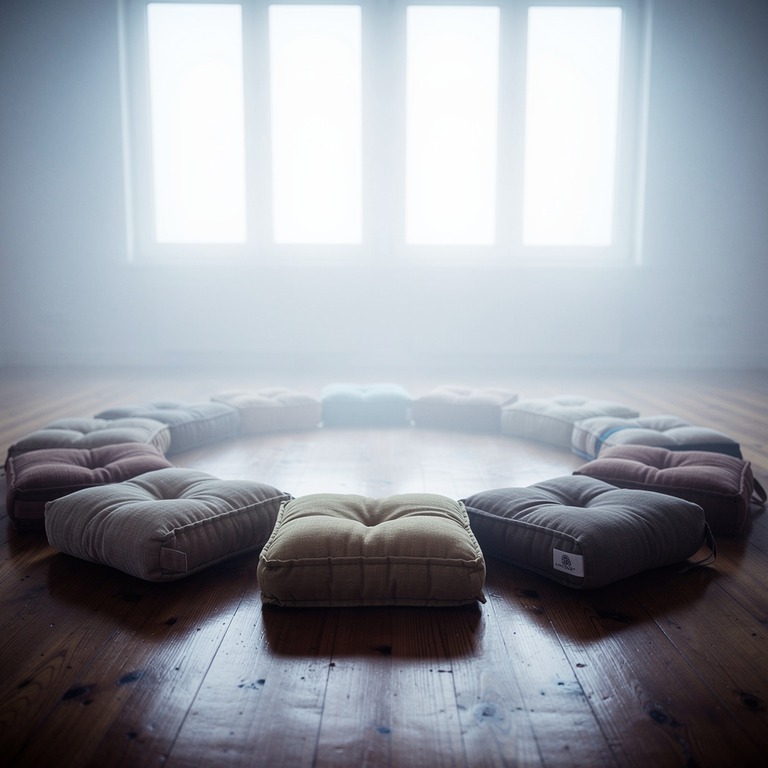
A 10-Minute Nourishing Breath Practice You Can Do Tonight
Set aside ten minutes. Phone in another room, or at least face-down on airplane mode. You can sit or lie down — lying down is kinder if your back is tired, but if you tend to doze off, sitting up keeps you honest. The point is to stay present, not to nap, although naps are also fine, just not the goal here.
Read through the practice once, then close your eyes and work through it from memory. It doesn't have to be perfect.
- Settle in. Take thirty seconds to scan your body. Notice where you're bracing — jaw, shoulders, the small of the back, the muscles around the eyes. Don't try to fix anything. Just notice. Let the places that want to soften, soften.
- Arrive in the breath. Breathe in and notice you're breathing in. Breathe out and notice you're breathing out. That's it. If counting helps you stay with it, count — one on the inhale, two on the exhale, up to ten, then start over. If counting feels like homework, drop it.
- Add a nourishing attitude. Place one hand on your chest, one on your belly. Feel the weight of your own hand. The warmth of it. This isn't performative — it's a signal to your nervous system that you are, in this moment, safe and tended to.
- Breathe in what you need. On the inhale, silently offer yourself something: calm, steadiness, kindness, courage. Pick one. On the exhale, let whatever is heavy soften a little. Not disappear — just loosen its grip.
- Close by acknowledging you showed up. That matters more than people give it credit for. Most of us skip the meditation. You didn't. Let awareness rest in the whole body for a moment. Then open your eyes.
When Anxiety Hijacks the Breath Entirely
A panic attack is partly a feedback loop. Shallow breathing triggers alarm, which triggers more shallow breathing, which triggers more alarm. The tricky part is that in the middle of one, the last thing you want to do is pay attention to your breath — because your breath feels like the problem.
The move isn't to force deep breaths. Forced deep breaths during panic often make it worse. Instead, try exhaling longer than you inhale. In for four, out for six. In for four, out for seven. The long exhale is what signals to your parasympathetic nervous system that the emergency is over, even if your mind hasn't caught up yet.
And give the feeling a name before you try to change it. "This is anxiety." Three words. Research on affect labeling shows that just naming what's happening reduces its intensity. The anxiety doesn't vanish — but it stops being this unnamed thing crushing your chest and becomes a specific, known experience you've had before and survived.
Why This Matters for Anyone Considering a Plant Medicine Retreat
If you're reading this because you're weighing whether to book an ayahuasca ceremony, an ibogaine program for addiction recovery, or a psilocybin retreat for depression — pay attention to your breath practice now. Months before you go, not the week of.
Here's the uncomfortable truth facilitators don't always spell out: psychedelic experiences can get rough. Not always — sometimes they're luminous from start to finish. But sometimes the medicine hands you something you've been avoiding for twenty years, and you have about forty-five seconds to decide whether to meet it or fight it. The people who do best in those moments aren't the ones with the best intentions or the fanciest retreat center. They're the ones who've built, through boring daily practice, the capacity to breathe through discomfort without immediately bolting.
Ten minutes a day of something like this meditation, over a few months, changes what you have access to when the ceremony gets intense. It won't guarantee a smooth journey. Nothing does. But it gives you a tool you can reach for when the rational mind has temporarily left the building.

Making It a Practice, Not a Project
Don't try to meditate for an hour starting tomorrow. That's the single most reliable way to quit by Friday. Start with five minutes. Same time each day if you can — right after you brush your teeth in the morning is a decent anchor, because you're already standing still and your brain hasn't yet filled with to-do lists.
Miss days. Everyone misses days. The practice isn't a streak to protect; it's a relationship to return to. The returning is the practice. Some mornings you'll sit down and feel calm within two breaths. Other mornings your mind will be a kicked beehive the entire time and you'll wonder why you bothered. Both are the practice. Neither tells you anything about whether it's working.
Working, in this context, isn't measured during the ten minutes. It's measured in the hours after — the slightly longer pause before you snap at someone, the slightly earlier moment you notice you're spiraling, the slightly softer landing when something hard happens. Those are the real markers. You don't feel them accumulating. Then one day you notice they already have.
For readers whose breath practice is pointing them toward something deeper — ceremony, integration, or structured psychedelic healing work — a range of thoughtfully curated plant medicine and meditation retreats can be browsed on our marketplace here. Whatever you decide, keep breathing. It's the oldest medicine we've got.
Craving More Stories?
Get your free guide on how to choose a psychedelic retreat, plus upcoming retreats and new reading every two weeks.
We value your privacy. Your email address will never be shared or published.